Explore how Western Weather Group checks, verifies, and maintains high-quality weather station data every day.
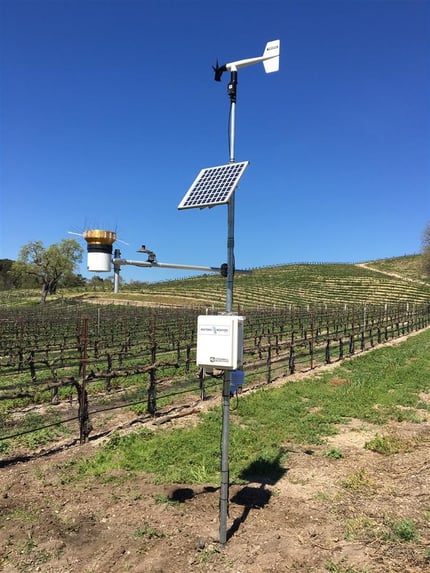 Congratulations! You, or someone you work with, are now the proud owner of a Western Weather Group (WWG) weather station (or a network of stations). Depending on what instrumentation is installed, that means you’re collecting real-time, ground-truth weather data. The range of observations could be anything: from air temperature and humidity, to rainfall, wind, soil moisture, and much more.
But how can you be sure that the data being collected is accurate? Well, that’s where our network health checks come into play, and how WWG really stands out. While our weather stations are industrial-grade, and quite resilient, sometimes things beyond your control can interrupt data flow from one or more sensors.
At WWG, we spend a lot of time behind the scenes making sure the data coming from your station, or any station we manage, is accurate, reliable, and ready to be used with confidence. To do so, there is a series of checks that are done to make sure that all weather stations that we manage show good, quality data.
Step one: Is the station reporting?
It sounds obvious, but this is one of the first, and most important, checks we do: “is the station on?”
Forecasting always starts with “what is happening right now” or “what happened yesterday.” If a station hasn’t reported in a while, the data is out of date and cannot be used. Up-to-date observations coming in from the field are crucial to our decision making.
We pride ourselves on taking data and information coming from our weather stations and using it as a component for the basis of our human-derived forecasts. This often reveals biases or errors in computer models and knowing that can then help us adjust our numbers accordingly to accomplish greater precision.
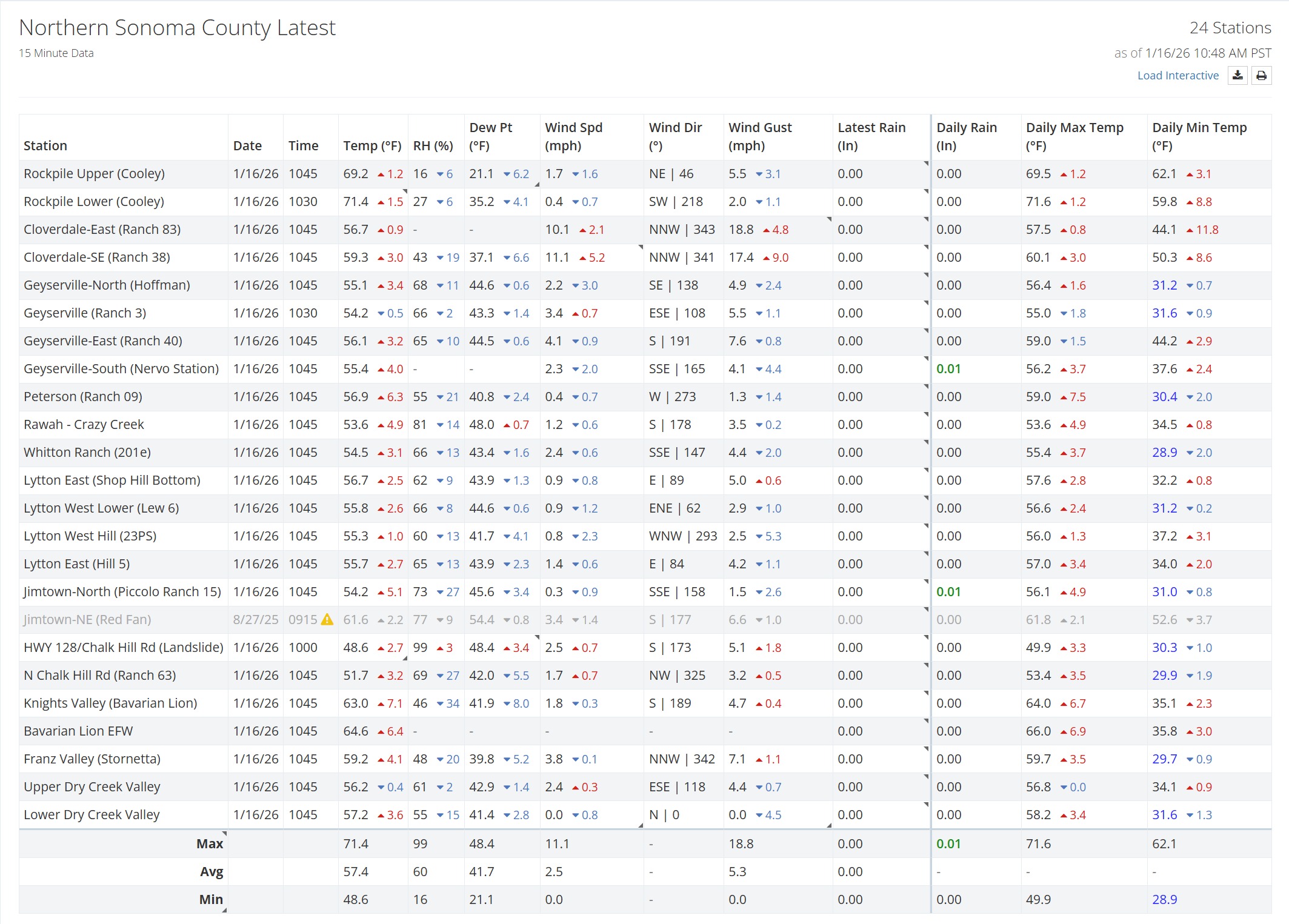
Out of date or old data is easily seen on both our forecasting products and on our online dashboards; the station will show data that is “greyed out,” not in the dark font color. Additionally, our online dashboards will also consider any missing data when doing statistical calculations, such as average or maximum temperature.
Step two: Identifying erroneous, inconsistent data with daily monitoring
Once we know a station is reporting, we move on to checking whether the data makes sense. We look for errors or readings that stand out when compared to nearby stations.
The best example of this is after the first major rainfall event of the water year. Inevitably, since weather stations are in the field in a lot of cases, damage or blockage of a rain gauge will occur. This in turn will then lead to what we call rain gauge “plugging”: rain is unable to reach the mechanism in the gauge that will measure the rainfall. This will show up on our forecasts as a station showing little to no rainfall, while nearby stations will have half an inch or more.
We run a wide range of data quality checks daily. These examples are just a sample of what we look for, not a comprehensive list, but they give a good idea of how we spot potential issues early:
- Maximum/minimum temperature: Is there a station that is significantly warmer/colder than its neighbors?
- Humidity: Does a station show very low dew point average/relative humidity average as compared to nearby stations?
- Wind speed/direction: Is a station showing 0 wind speed or lack of change of direction? This is almost virtually impossible as even a very calm wind day will still produce a little bit of air movement.
And that is essentially what is done daily by our forecasting team here at WWG.
Step three: Weekly deep dives
Now, admittedly, that is a very surface level check, and we are only human after all, which is why on a weekly basis, a deeper dive into the overall health and status of our entire agricultural station network is performed by me personally.
In this check, I will compile various data from all our weather stations and can then take a closer look at the various issues, and, more importantly, why these stations are having issues.
Take for example our lengthy streak of fog and low clouds in the Central Valley that lasted from late November into mid-December of 2025. During this time, over two dozen stations ended up losing connection with our data platform. By looking closer into the data, I was able to determine that the persistent fog prevented the batteries in these stations from properly charging. While this over a short time period is not usually an issue, the lengthy lack of charging caused all the batteries to gradually lose voltage, eventually dropping low enough for them to completely die.
Finding the why behind issues like this helps us respond faster and plan smarter going forward.
Step four: From detection to resolution, Field Services in action
Now that we’ve identified which stations are out of date or showing questionable data, the next step is acting. That’s where our Ag Field Services team comes in.
Once an issue is flagged, either by WWG or a client, it’s logged and passed along to Field Services for follow-up and resolution.
From there, the usual procedure involves contacting the station owner/caretaker and determining a course of action to rectify the problem. If needed, the Field Services team will be activated and fix the problem, but usually the fix can be as simple as having somebody associated with the station go out and fix it themselves; for example, clearing a leaf from a rain gauge.
Step five: You become part of the quality process
There is another kind of check that is done as well; and that’s by you, the owner (observer) of the weather data.
If you use the data regularly, you’re often the first to notice when something doesn’t look right. Maybe the temperature seems off, rainfall looks suspicious, or a sensor appears it hasn’t updated in a while. When that happens, we encourage all who use our weather data to inform us if something is wrong.
From there, WWG can then provide instruction, material, or service to resolve the issue. Often things are fixed the quickest when noticed by others.
Step six: Enhancing data quality with AI-assisted monitoring
What comes next, you may ask? WWG is advancing data quality by introducing AI to help detect and flag anomalies.
AI tools can scan enormous amounts of data at once and spot subtle problems that are easy to miss. Of course, anything flagged will still be reviewed by a real human because context matters.
The result? Fewer missed issues, faster fixes, better checking, less downtime, and even more reliable data for everyone.
Western Weather Group’s commitment to reliable weather data
And that’s about it as far as ensuring data is checked and verified. Of course, no method is perfect, which is why across our organization, we are consistently looking at ways to improve our methodology and have multiple algorithmic layers and humans monitoring data flowing in.
As your station network grows, our health checks will scale along with it. Our goal is simple: ensure that the weather data from our stations is timely, precise, and accurate, so you can trust it when it matters most.